 |
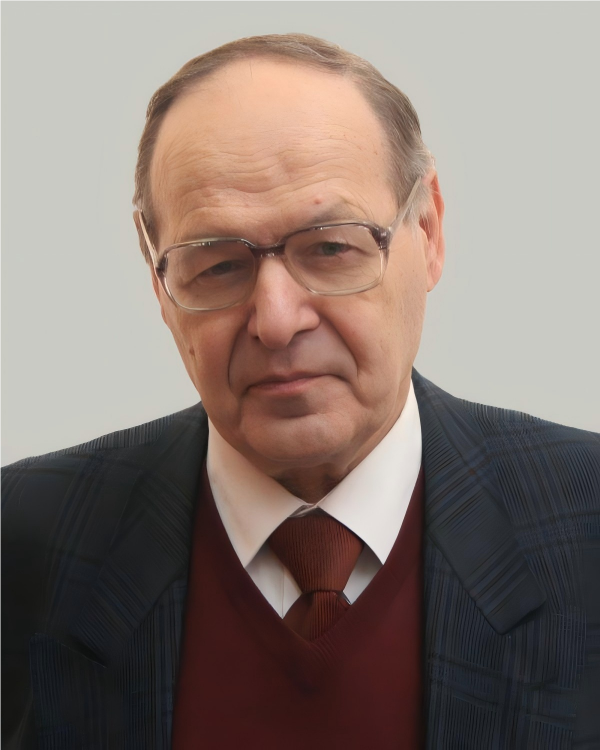
报告人: |
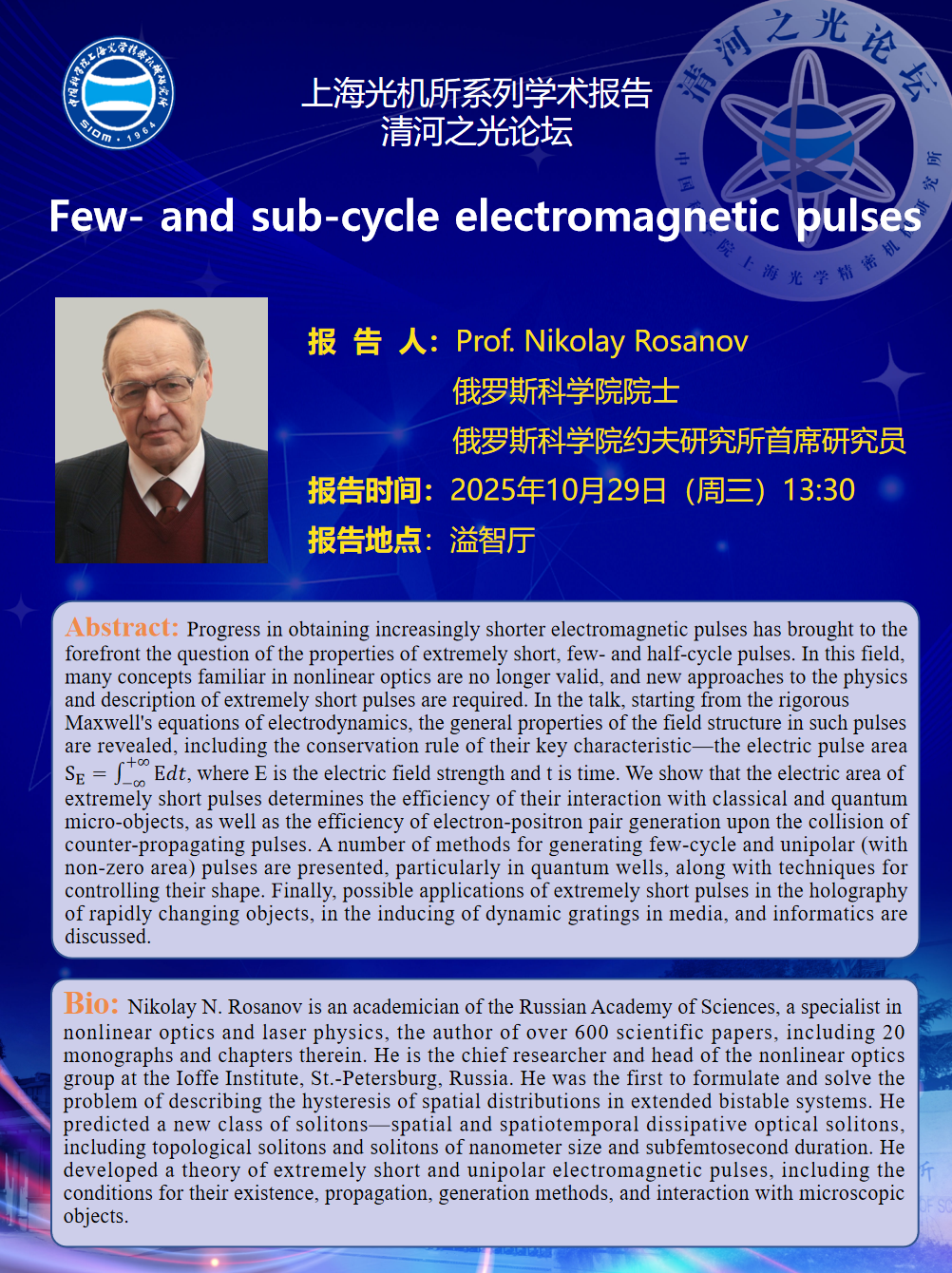
Prof. Nikolay Rosanov |
| 报告题目: |
Few- and sub-cycle electromagnetic pulses |
| 报告时间: |
2025年10月29日(周三)13:30 |
| 报告地点: |
溢智厅 |
|
|
| 报告人简介 |
|
Nikolay N. Rosanov is an academician of the Russian Academy of Sciences, a specialist in nonlinear optics and laser physics, the author of over 600 scientific papers, including 20 monographs and chapters therein. He is the chief researcher and head of the nonlinear optics group at the Ioffe Institute, St.-Petersburg, Russia. He was the first to formulate and solve the problem of describing the hysteresis of spatial distributions in extended bistable systems. He predicted a new class of solitons—spatial and spatiotemporal dissipative optical solitons, including topological solitons and solitons of nanometer size and subfemtosecond duration. He developed a theory of extremely short and unipolar electromagnetic pulses, including the conditions for their existence, propagation, generation methods, and interaction with microscopic objects. |
| 报告简介 |
|
Progress in obtaining increasingly shorter electromagnetic pulses has brought to the forefront the question of the properties of extremely short, few- and half-cycle pulses. In this field, many concepts familiar in nonlinear optics are no longer valid, and new approaches to the physics and description of extremely short pulses are required. In the talk, starting from the rigorous
Maxwell's equations of electrodynamics, the general properties of the field structure in such pulses are revealed, including the conservation rule of their key characteristic—the electric pulse area S_E=∫_−∞^+∞▒Edt, where E is the electric field strength and t is time. We show that the electric area of extremely short pulses determines the efficiency of their interaction with classical and quantum micro-objects, as well as the efficiency of electron-positron pair generation upon the collision of counter-propagating pulses. A number of methods for generating few-cycle and unipolar (with non-zero area) pulses are presented, particularly in quantum wells, along with techniques for controlling their shape. Finally, possible applications of extremely short pulses in the holography of rapidly changing objects, in the inducing of dynamic gratings in media, and informatics are discussed. |
| 本期论坛海报 |
|
| |


 附件列表:
附件列表: